
Agile Effort Estimation Techniques
12 min readBy Aerotix

Agile effort estimation techniques play a crucial role in project planning and execution by providing teams with insights into the amount of work required for various tasks or user stories.
Unlike traditional methods that rely on precise estimates, Agile techniques focus on relative sizing and iterative refinement to adapt to changing requirements and uncertainties.
Some common Agile effort estimation techniques include:
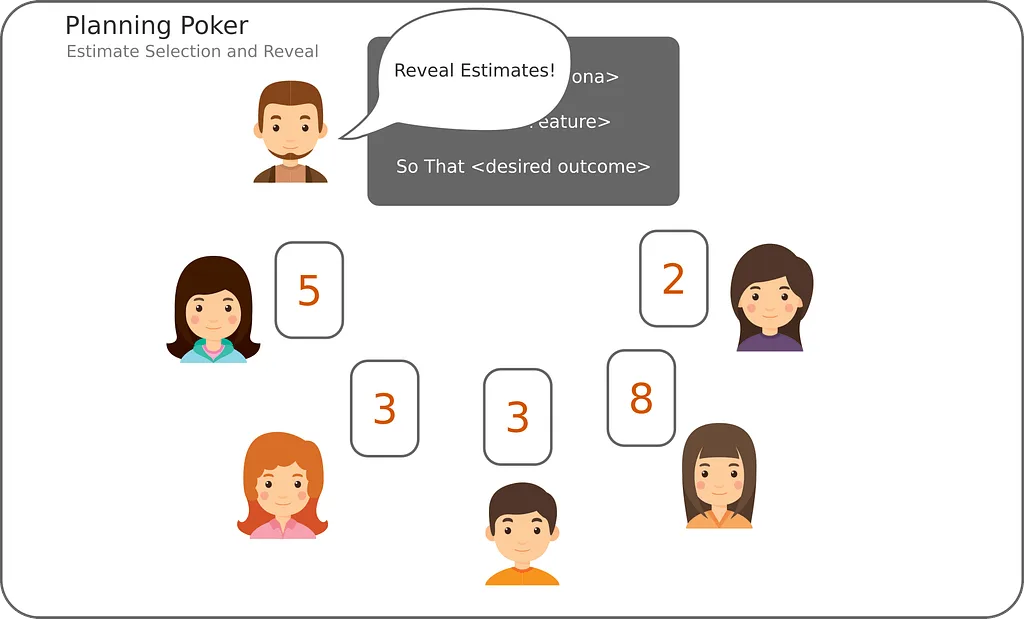
Planning Poker™: This renowned technique involves consensus-based estimation, typically used for a small number of items (under 10). Each team member possesses a deck of cards featuring numbers from the Fibonacci sequence. By anonymously selecting and revealing their estimates simultaneously, biases are minimized, fostering objective discussions.
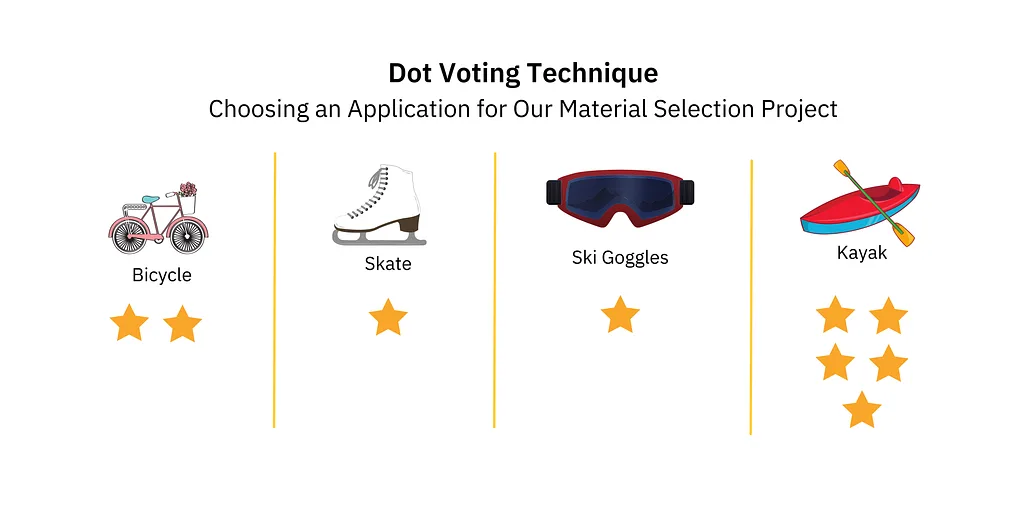
Dot Voting: Similar to Planning Poker, Dot Voting proves effective for sprints with a limited number of Sprint Backlog items. Team members utilize color-coded dot stickers to denote the estimated effort required for each item, facilitating quick and visual estimation.
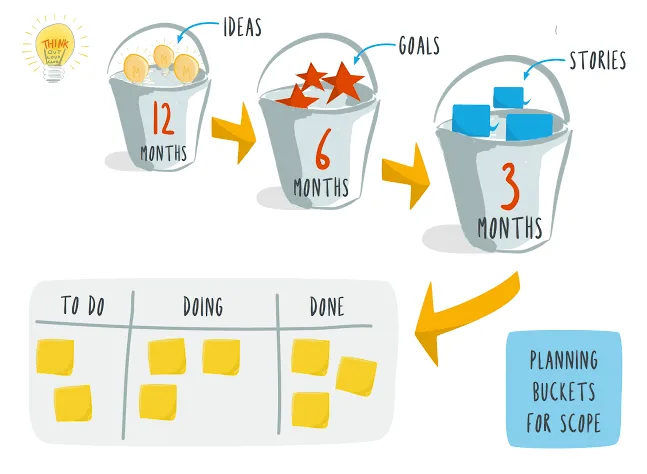
The Bucket System: Ideal for backlogs containing numerous items, the Bucket System swiftly categorizes items based on pre-determined complexity “buckets.” Team members place each item along a line of numbered note cards, streamlining the estimation process while ensuring comprehensive coverage.
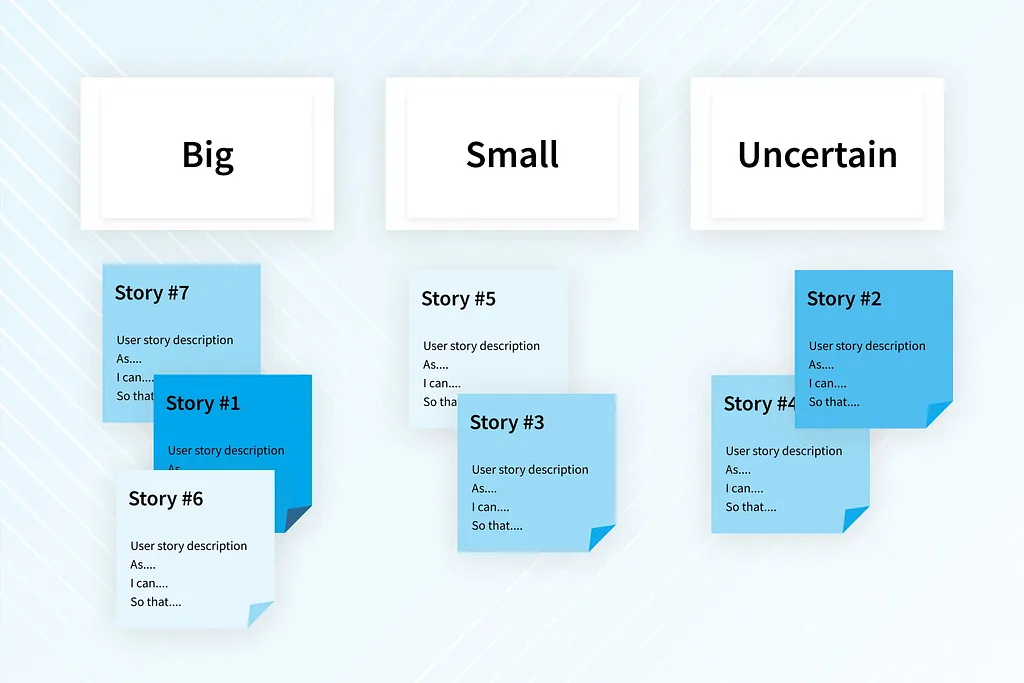
Large/Uncertain/Small: This method offers a rapid approach to rough estimation, particularly suitable for backlogs featuring comparable items. By categorizing items into three broad categories — large, uncertain, and small — teams quickly gauge the relative effort required for each item.
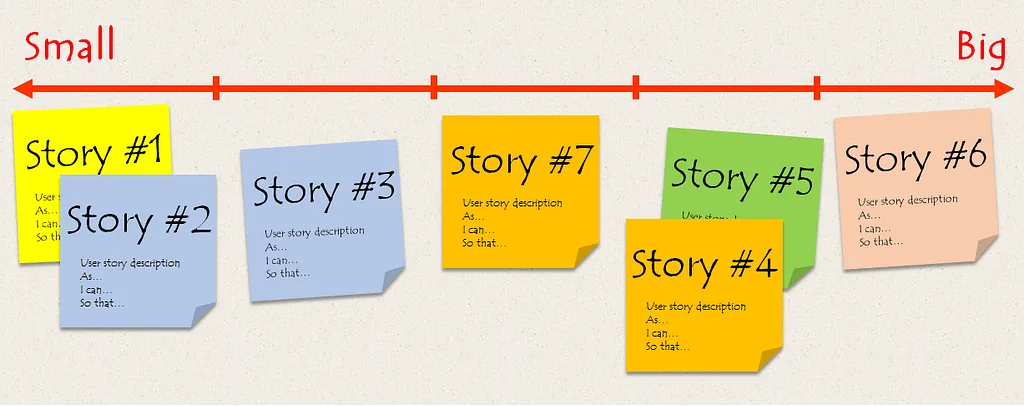
Ordering Method: Suited for projects with a sizable backlog and a smaller team, the Ordering Method involves iteratively arranging items along a scale, allowing team members to adjust their positions until a consensus is reached.
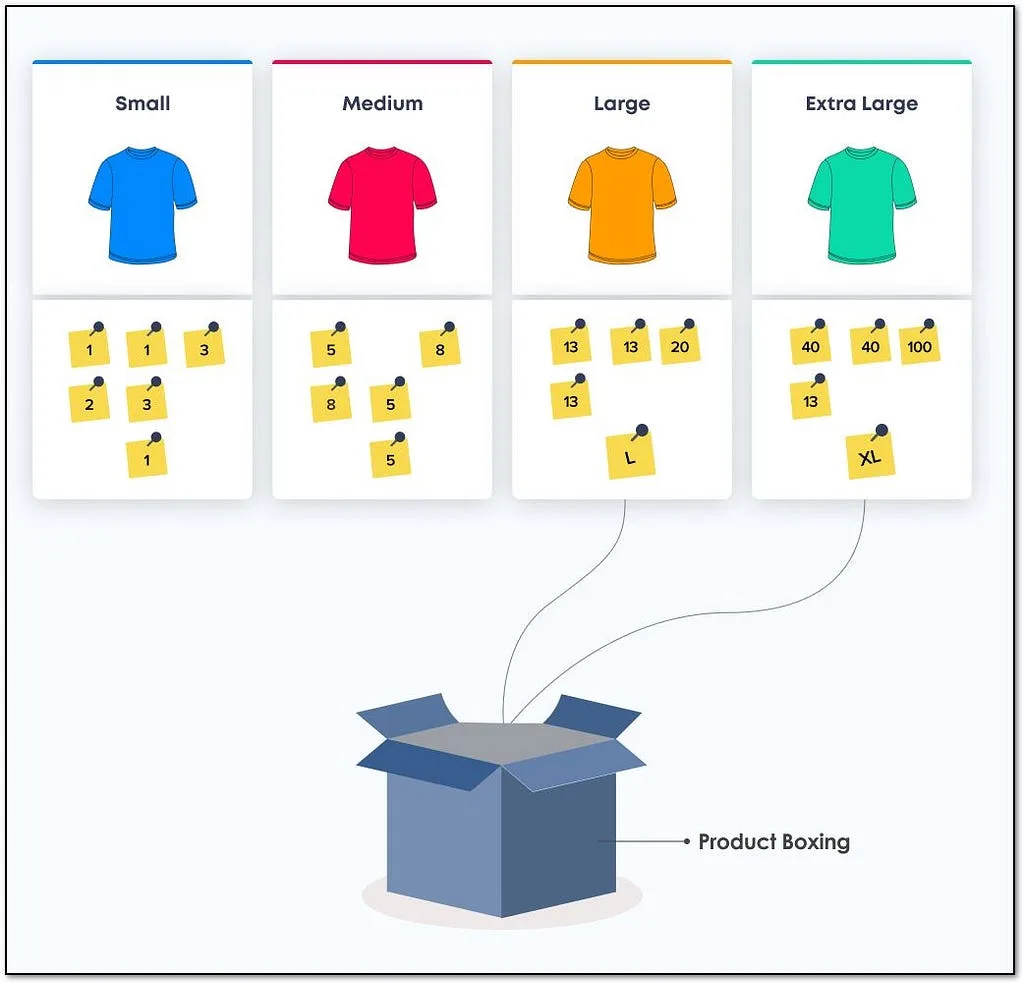
Affinity Mapping: For backlogs comprising over 20 items, Affinity Mapping proves invaluable. Through collaborative grouping of items based on thematic similarities, teams prioritize tasks and gain clarity on project direction.
Planning Poker™:-
Estimating with Planning Poker™ involves a collaborative process where team members assign effort estimates to user stories or tasks using a deck of cards with numbers from the Fibonacci sequence. Here’s how to estimate with Planning Poker™:
Preparation:
Ensure that the Product Backlog is refined and contains a set of user stories or backlog items that need to be estimated.
Gather the necessary materials, including Planning Poker decks or sets of cards with numbers from the Fibonacci sequence (0, 1, 2, 3, 5, 8, 13, 21, etc.), and a visible surface for the estimation session.
2. Setup:
Introduce the Planning Poker technique to the team and explain its purpose in estimating effort or complexity.
Distribute a Planning Poker deck to each team member, ensuring that each deck contains cards with numbers representing different levels of effort or complexity.
Designate a facilitator to lead the estimation session and guide the team through the process.
3. Estimation Process:
Present one user story or backlog item at a time to the team for estimation.
Each team member privately selects a card from their Planning Poker deck that they believe represents the effort or complexity of the item.
To maintain fairness and avoid bias, team members are encouraged to keep their chosen cards hidden from the rest of the team until all cards have been selected.
Once all team members have chosen a card, everyone reveals their selections simultaneously by turning their cards face up.
4. Discussion and Consensus:
If there is a wide discrepancy in the estimates, team members are encouraged to discuss their reasoning and assumptions behind their chosen cards.
The facilitator facilitates the discussion and encourages team members to share their perspectives while aiming to reach a consensus on the estimated effort or complexity.
Team members may choose to re-estimate the item using Planning Poker cards if consensus cannot be reached initially.
5. Finalization:
Once a rough consensus is reached, the estimated effort or complexity for the user story or backlog item is recorded.
Repeat the estimation process for each subsequent user story or backlog item until all items have been estimated.
Document the final estimates and ensure that they are visible and accessible to all team members for future reference.
Fibonacci sequence:-
The Fibonacci sequence is a series of numbers where each number is the sum of the two preceding ones, usually starting with 0 and 1. In mathematical terms, it can be defined by the recurrence relation: F(n) = F(n-1) + F(n-2), with initial conditions F(0) = 0 and F(1) = 1.
The sequence begins: 0, 1, 1, 2, 3, 5, 8, 13, 21, 34, 55, and so on.
The Fibonacci sequence has many interesting properties and applications in mathematics, nature, and computer science. In Agile estimation, Fibonacci numbers are often used in Planning Poker™ to provide a relative scale for estimating the effort required for tasks or user stories. Each number in the Fibonacci sequence corresponds to a Planning Poker card that team members use to indicate their estimates during the estimation process.
Dot Voting:-
Estimating with Dot Voting involves a collaborative process where team members assign effort estimates to user stories or tasks using colored dot stickers. Here’s a step-by-step guide on how to estimate with Dot Voting:
Preparation:
Ensure that the Product Backlog is refined and prioritized before the estimation session.
Gather the necessary materials, including user story cards or a list of tasks, colored dot stickers, and a visible surface such as a whiteboard or wall.
2. Explanation of User Stories:
The Product Owner (PO) or facilitator explains each user story or task to the team, providing relevant context, acceptance criteria, and any other information needed for understanding.
3. Distribution of Dot Stickers:
Provide each team member with a set of dot stickers in different colors, each color representing a different level of effort or complexity (e.g., small, medium, large).
It’s essential to agree on the meaning of each color beforehand, such as using green for small, blue for medium, and red for large.
4. Placement of User Stories:
Display the user stories or tasks visibly, either on a whiteboard, wall, or as printed cards on a table.
Ensure that each item is clearly labeled and easily accessible to all team members.
5. Voting Process:
Each team member individually evaluates the effort required for each user story or task and places their dot stickers next to the corresponding items.
Team members can allocate their dots based on their judgment of the complexity, uncertainty, or size of each item.
Encourage team members to distribute their dots among different items according to their perceived effort level.
6. Group Discussion:
Once all team members have placed their dots, review the distribution of dots on each item.
Discuss any significant discrepancies or outliers in the estimations. Encourage team members to explain their reasoning behind their estimates.
Facilitate a collaborative discussion aimed at aligning the team’s understanding of the effort required for each item.
7. Consensus Building:
Work towards a rough consensus on the effort estimates for each user story or task.
Adjust the estimates if necessary based on insights shared during the discussion.
8. Recording of Estimates:
Record the final estimates for each user story or task, typically using the agreed-upon color-coding system.
Update the Product Backlog or estimation board with the finalized estimates for future reference.
The Bucket System:-
The Bucket System is a rapid estimation technique used to size items in a backlog quickly and effectively. Here’s how to estimate with The Bucket System:
Preparation:
Ensure that the Product Backlog is refined and prioritized before the estimation session.
Gather the necessary materials, including sticky notes or note cards, markers, and a visible surface such as a whiteboard or wall.
2. Setup:
Create a line of note cards or sticky notes down the center of the table, each marked with a number representing a level of effort or complexity.
The numbers typically range from low to high, with each card representing a different level of effort (e.g., 1, 2, 3, 5, 8, 13, etc.).
3. Item Selection:
Write each item or user story from the Product Backlog on separate sticky notes or note cards.
Ensure that each item is clearly labeled and easily accessible to all team members.
5. Estimation Process:
One by one, team members randomly select an item or user story and read it aloud to the group.
Each team member then places the item on the line of note cards according to their judgment of its relative effort or complexity.
There is no need for discussion during this process, and team members should spend no more than a predetermined time limit (e.g., 120 seconds) on each item.
6. Adjustment and Discussion:
After all items have been placed on the line of note cards, team members can discuss any discrepancies or outliers in the estimations.
If a team member disagrees with the placement of an item, they can suggest moving it to a different position on the line.
The team can discuss and adjust the placement of items until a rough consensus is reached.
7. Finalization:
Once the team is satisfied with the placement of all items, the estimation process is complete.
Record the final estimates for each item, either by noting the position of each item on the line of note cards or by assigning a corresponding number from the line to each item.
Ensure that the estimates are visible and accessible to all team members for future reference.
Large/Uncertain/Small:-
The Large/Uncertain/Small technique is a simple and quick method used for rough estimation, particularly suitable for backlogs containing several similar or comparable items. Here’s how to estimate using the Large/Uncertain/Small technique:
Preparation:
Ensure that the Product Backlog is refined and prioritized before the estimation session.
Gather the necessary materials, including sticky notes or note cards, markers, and a visible surface such as a whiteboard or wall.
2. Setup:
Create three columns labeled “Large,” “Uncertain,” and “Small” on the visible surface (e.g., whiteboard or wall).
3. Item Selection:
Write each item or user story from the Product Backlog on separate sticky notes or note cards.
Ensure that each item is clearly labeled and easily accessible to all team members.
4. Estimation Process:
Starting with the simpler, more obvious user stories, present each item to the team one by one.
The team collectively decides whether the effort required for each item falls into the categories of Large, Uncertain, or Small.
Large: Items that are expected to require a significant amount of effort or complexity.
Uncertain: Items for which the effort or complexity is difficult to determine or predict with confidence.
Small: Items that are expected to require minimal effort or complexity.
5. Discussion and Adjustment:
After placing each item into one of the three categories, the team can discuss any discrepancies or uncertainties in the estimations.
If there is disagreement among team members about the categorization of an item, the team can discuss and adjust its placement until a rough consensus is reached.
6. Finalization:
Once all items have been categorized, the estimation process is complete.
Record the final estimates for each item, either by noting the category of each item on the sticky notes or by assigning a corresponding label (Large, Uncertain, Small) to each item.
Ensure that the estimates are visible and accessible to all team members for future reference.
Ordering Method:-
The Ordering Method is a technique used for estimating effort or complexity in projects with a smaller team and a large number of Product Backlog items. Here’s how to estimate using the Ordering Method:
Preparation:
Ensure that the Product Backlog is refined and prioritized before the estimation session.
Gather the necessary materials, such as a visible surface like a whiteboard or wall, markers, and sticky notes or index cards.
2. Setup:
Prepare a scale ranging from low to high on the visible surface. This scale represents the effort or complexity level, with low on one end and high on the other.
Place the scale on the visible surface so that team members can easily access it during the estimation process.
3. Estimation Process:
One by one, present each item or user story from the Product Backlog to the team.
Each team member then decides whether the effort or complexity of the item is closer to the low end or the high end of the scale.
Based on their judgment, team members move the item along the scale to reflect its relative position.
4. Adjustment and Discussion:
After all items have been placed on the scale, team members can discuss any discrepancies or disagreements in the estimations.
If there is disagreement about the placement of an item, team members can discuss and adjust its position on the scale until a rough consensus is reached.
5. Finalization:
Once all items have been placed on the scale and the team is satisfied with the estimations, the estimation process is complete.
Record the final estimates for each item, either by noting the position of each item on the scale or by assigning a corresponding label (e.g., low, medium, high) to each item.
Ensure that the estimates are visible and accessible to all team members for future reference.
Affinity Mapping:-
Affinity Mapping is a collaborative technique used to organize and prioritize large sets of information, such as user stories or backlog items. Here’s how to use Affinity Mapping for estimation:
Preparation:
Ensure that the Product Backlog contains a significant number of items that need to be organized and prioritized.
Gather the necessary materials, including sticky notes or index cards and markers.
Set up a visible surface like a whiteboard or wall where the Affinity Mapping exercise will take place.
2. Setup:
Begin by introducing the Affinity Mapping technique to the team and explaining its purpose.
Divide the visible surface into sections or columns to represent different categories or themes that the items will be grouped into.
Label each section or column with a category or theme that reflects the common attributes of the backlog items.
3. Mapping Process:
Write each backlog item or user story on a separate sticky note or index card.
Invite team members to read out each item and place it in the section or column that best represents its category or theme.
Encourage team members to group items based on similarities, patterns, or themes that emerge during the exercise.
Allow team members to move items around and regroup them as needed to create logical clusters.
4. Discussion and Consensus:
As the items are being grouped, encourage team members to discuss the rationale behind their placements and to identify any overlaps or discrepancies.
Facilitate open communication and collaboration among team members to ensure that everyone’s perspectives are considered.
Aim to reach a rough consensus on the grouping and prioritization of backlog items by the end of the exercise.
5. Prioritization and Finalization:
Once all backlog items have been grouped and prioritized, review the clusters to ensure that they accurately represent the team’s understanding of the project requirements.
Assign a name or label to each cluster that reflects its overarching theme or category.
Prioritize the clusters based on their importance or relevance to the project goals, ensuring that the most critical items are addressed first.
6. Documentation:
Document the results of the Affinity Mapping exercise, either by taking photos of the grouped items or by creating a digital record of the clusters and their prioritization.
Share the outcomes of the exercise with the team and stakeholders to inform future planning and decision-making processes.
In conclusion, Agile estimation practices are pivotal for teams to accurately forecast effort and complexity. These methods foster collaboration, transparency, and alignment, enabling teams to plan effectively and deliver value efficiently. By employing Agile estimation, teams can navigate uncertainties, adapt to changes, and drive project success.
You may also refer to the other articles to ensure comprehensive familiarity with the information provided.